Good enough

It was very good. (Genesis 1:31)

In the beginning of the story of the world and of human beings, we learn we are inherently good. We are created in the image and likeness of the Creator. We are birthed out of love itself.

This does not mean we are without fault or that we don’t always live into our birthright, but it does mean we are not awful like many religious folks lead us to believe.

Yes, we can run to Paul and talk about flesh, of sinful nature, but we must be careful that we are not projecting Platonism onto the words of a Jewish thinker.

We are not born sinful. We are not sinful at our core. We are beings created in the image and likeness of Love who often fall short of what we could be.

I have spent most of my life thinking I’m not good enough, when the reality is I have always been good enough. I need to realize and accept this and live accordingly.

For years, I was drawn to religions that reinforced I wasn’t good enough. I can no longer live in that world of thinking.

I realize that much of the thinking in American Christianity affirms the “we aren’t good enough” story, so no matter where I go, it will likely be in the air.

I am learning to breath a different kind of air, a fresher kind of air. An atmosphere where I find life in knowing that I am good enough no matter what I do.

That is the point of grace. A God who said from the beginning, “it is very good,” continues to see worth in all creation.

Yes, creation is broken. Yes, I contribute to that brokenness. But my value and worth are not determined by my brokenness. My ability to be loved and accepted by God is not determined by my brokenness. Rather, my brokenness causes me to be blinded to what always has been and always will be true.

I am loved.

I am accepted.

I am good.

I am good enough.

I no longer live to earn my worth, but rather to recognize it and live into it.

A community of faith

This morning I stood before a gathering of people who come together every Sunday to celebrate and remember what God is doing in the world. They also come together at various other times to engage in the work of the Kingdom, the embodiment of the Gospel.

That is part of what drew me to stand before these men, women, and children this morning and speak the following words as I committed myself to the community of St. John’s Lutheran Church…

I did not grow up in a community of faith, but over 20 years ago in my journey of faith, I was a part of this church community. Since then, I have lived around the Midwest, serving several churches in ministry and growing in my understanding of God and God’s mission in the world.

Several years ago, I moved back home to be closer to family. Over the last few years, my life has seen significant transition, including a desire to find a new faith community to share life with. From the moment I entered this building earlier this year, it felt like home. Of course, it helped knowing the Thompsons, who I have known since Eric and I went to school together many years ago. But it is also the many others I have gotten to know these last few months that have helped me come to this decision to call St. John’s home.

I look forward to joining you in your mission. I look forward to getting to know you all better. I look forward to being part of a community where God’s grace, mercy, love, and peace are present.

I have learned during my journey of faith that the size of a congregation does not necessarily determine the spiritual health or missional engagement of that church. Some of the people who do the most meaningful Kingdom work gather in small buildings with communities where everyone knows each another.

This does not mean this is the perfect church. If such a place even existed, I would ruin it the minute I showed up. What I do find here is what was described in the words I shared this morning.

Anyone who desires to engage in the work of the Kingdom should seek a community of faith. I honestly don’t think God loves you any less if you don’t “go to church.” However, there is incredible value and irreplaceable benefits from being in community.

I spent most of this last year without a community of faith to call home. There are many reasons for stepping away for a season. Maybe you were hurt by someone at a church. Maybe your journey has taken you to a place where the way you express your faith needs a different setting. Maybe you need some space to heal. Everyone’s reason is different. But if you ever find yourself without a place to call home, my encouragement is for you to pray, listen, and be open to where the Spirit may lead you.

I hope you don’t look at “going to church” as something you do to appease God. If that is your motivation, please understand God isn’t in the business of taking attendance. Rather, God’s dream for you is a better understanding of grace, love, mercy, and peace. When you find a place that offers that, it might just be somewhere to call home.

Hurt people hurt people

Have you ever come upon an injured animal? They are afraid. They are defensive. They interpret any movement towards them as an attack.

The reality is we human beings aren’t much different, except we often can’t see the injuries. Rather than a scratch, bleeding wound, or some other physical injury, the wounds are often much more profound, buried deep inside the soul.

When we are hurt, we tend to hurt others. Unfortunately, that means we often hurt those we love and those who love us. In our efforts to protect ourselves from being hurt one more time, we strike first. Sometimes with aggression and other times with exclusion. We will usually attack or withdraw, causing pain either way.

This reminds me of something I’ve come across several times in the Bible. The book of Numbers says it this way… “’The Lord is slow to anger and abounding in steadfast love, forgiving iniquity and transgression, but he will by no means clear the guilty, visiting the iniquity of the fathers on the children, to the third and the fourth generation.’” (Numbers 14:18 ESV)

Maybe this verse is more descriptive than prescriptive. Maybe the reason iniquities are passed down from one generation to the next isn’t because God makes it happen, but rather because we can’t accept and pass on the love we are offered by God. Maybe part of clearing guilt is our work.

I have witnessed hurt people hurting people in my life more times than I care to count. Sometimes I have done the hurting and other times I have been hurt. I have attacked and withdrawn and been on the receiving end of both as well.

I have been learning that as we heal, we become agents of healing. As we wrestle with our hurts, name them and face them, we begin to find relief. This in turn allows us to extend compassion, not hurt, even when our instinct tells us to hurt back.

This is not an easy journey, nor one that is traveled in a straight line. However, I can tell you that the further down this path I travel, the less I find myself lashing out or pulling away when the hurt rises to the surface in my life. I’m finally learning, slowly but surely, to break the cycle of hurts for hurts, and in the process forgiveness, compassion, and Shalom are becoming more tangible in my life.

Where is God?

Sometimes things happen in life that make no sense to me. Situations that turn out in ways that defy logic and seem an affront to justice. Times when life feels like a desert wasteland.

What do we do when this happens? How do we react to moments that crush our souls and defeat our spirits?

There are a few things I don’t believe…

I don’t believe that this is all part of God’s plan. The idea that God would intentionally put someone through hell as part of a plan or to teach something is what I would call theological horse manure. That flies in the face of a loving, merciful God.

I don’t believe that everything happens for a reason. Everything happens, but not “for a reason.” Things happen because we live in a broken world inhabited by broken people. And sometimes those people do really hateful and evil things.

There are a few things I do believe…

I believe that God suffers with us. In the midst of our pain, suffering, and anger, the One who dwells in us dwells with us through the most agonizing moments of life.

I believe there will come a day when things will be made completely right, but that final, ultimate realization is not on this side of death. Life sucks sometimes; it really does. We are promised a new heaven and a new earth through resurrection. Resurrection is an already/not yet proposition, and we live in the tension between the two.

I hurt for those who suffer, especially when brought on by the evil of others. God sees the evil perpetrated in the world, but that doesn’t mean that God will intervene directly. I don’t know why it seems God acts in some situations and doesn’t in others. I do know I’m tired of platitudes such as “God will take care of this” and “this is all part of the plan.”

Sometimes life is hell. Plain and simple. Sometimes people hurt other people. And sometimes it’s even intentional and malicious.

So what do we do?

I don’t have all of the answers, or even most of them, but I do know this: I have agency to fight against darkness in the world. I may not be able to remove the pain, but I can be present with others while they hurt. I may not be able to make things better, but I can be light in the midst of darkness.

Where is God in the midst of hell on earth?

In me.

God, in the person of Jesus Christ, stepped into the hurt and darkness and confronted it to the point of his own suffering and even death. If I’m committed to following Jesus’ way of life and his mission, shouldn’t I be willing to do the same?

All language is metaphor

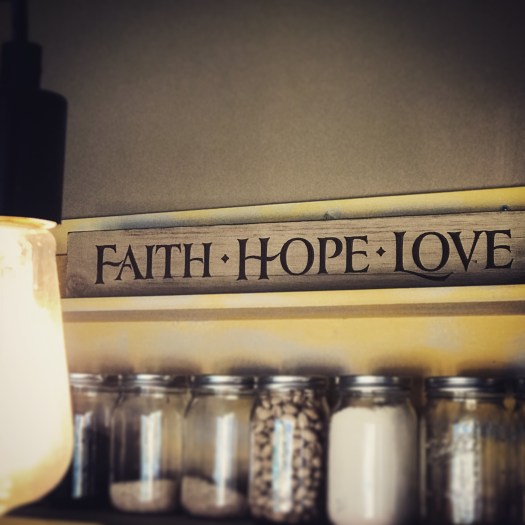
What do the three words in this image mean? If I asked, I would expect a range of answers, some very similar and others different.

The problem is all words are metaphor. This is certainly not an original idea of mine, but something I have wrestled with, especially lately.

In recent conversations, my words were misunderstood and interpreted in ways other than intended. This has happened my whole life, but it was especially poignant recently. I was reminded what I say is not always what someone else hears. And the same is true when I am the listener.

Language is a metaphor to communicate ideas, feelings, beliefs, and more, one of the primary vehicles for sharing our heart and mind with others. It is however, like every aspect of our humanity, imperfect. I select a word or phrase to communicate my thoughts and feelings. The other person hears those words through a different filter shaped by their thoughts, feelings, and experience. Misunderstandings are inevitable.

This has profound impact on every aspect of our life when human interaction occurs.

In the public arena, unnecessary, divisive conflicts between different groups can arise. One misunderstood word can evolve into months or even years of escalating and ongoing turmoil.

In our personal relationships it can cause hurt feelings, separations, fights, and a host of other problems. One misunderstood phrase can damage a friendship or relationship, even to the point of a permanent fracture.

In our religious world, it can wreak all kinds of havoc. One misunderstanding of religious literature can cause inquisitions, crusades, racism, division, terrorism, judgmentalism, and other problems, many of which haunt our world to this day.

This does not mean words don’t matter. They are crucial. But we must always remember they are metaphor, one of our best, albeit imperfect, methods to communicate with one another. Even the words I write here may offend someone, even if, and often because, they are hearing something other than I am attempting to convey.

Words are vitally important and we must exercise caution with the words we use. Words have power. Power to hurt and power to heal. Power to fuel hate and power to create love. Power to expose the worst of us and power to reveal the best we have to offer.

We all have a responsibility when it comes to langauge. We must be good speakers and writers as well as good listeners and readers. We must seek to understand before we react, to attempt to enter the world of the other.

Too many wars and fights and too much murder and persecution have resulted from misappropriated or misunderstood language. We cannot control what someone else says, but we can work to discern what we say and how we react to what we hear.

I know I need to be better about this every time I open my mouth, sit down in front of my laptop, listen to another person, or read what someone has written. I am sure the world around me can be better place if I practice the words I have written here today.