
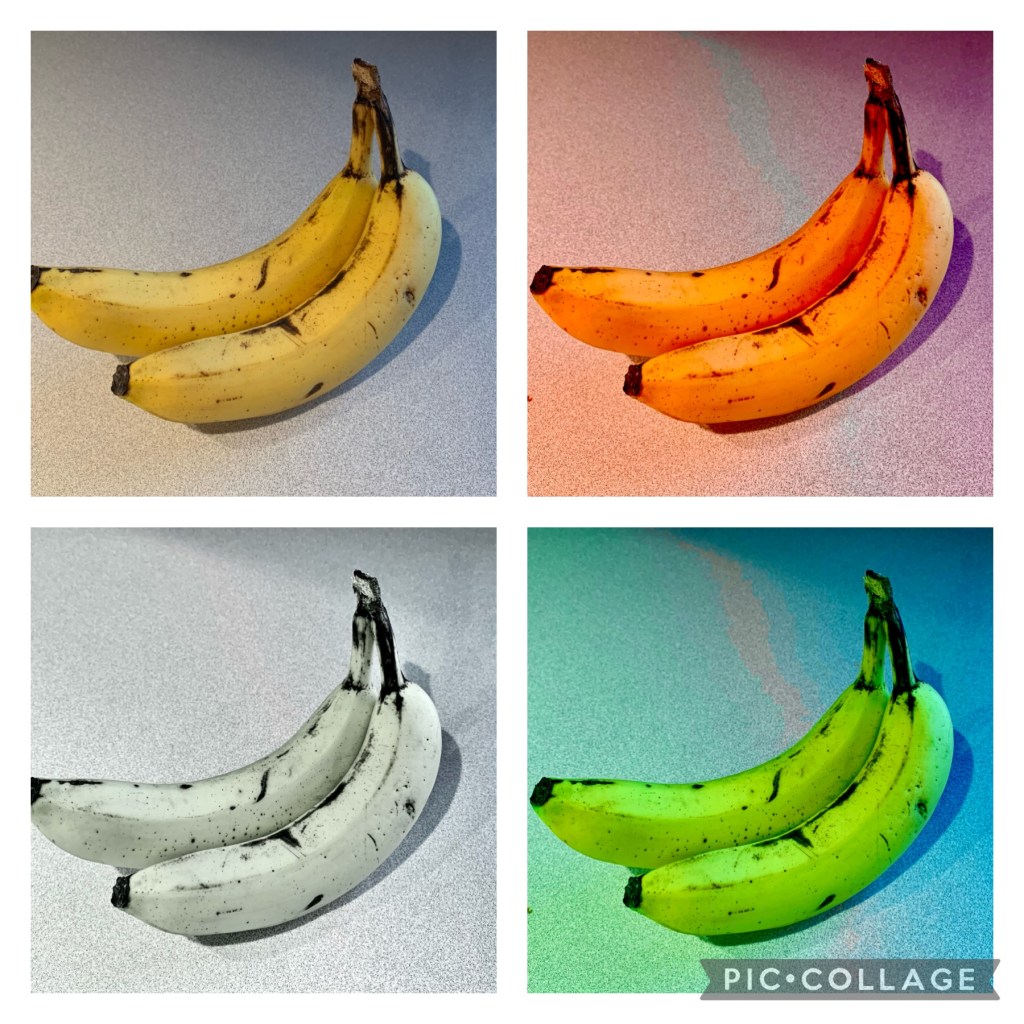
Did you know bananas are not only yellow, but they can be orange and gray and lime colored too?
Obviously, they are not, at least not naturally. But with the right filters and editing, I can make bananas just about any color I want.
Bananas aren’t the only things whose appearance we alter with filters. Across most social media platforms we use filters to give photos features such as brighter colors, more contrast, and even less wrinkles.
I’m not here to bemoan filters; I use them often in my photography. They are a useful tool to enhance an image and serve as part of its artistry.
However, what happens when we apply filters to us, to how we appear to the world…and ourselves?
We all do it. We present ourselves in certain ways as an attempt to achieve desires results: success, acceptance, prestige, attention, compliments, rejection, and so on.
Filters aren’t always bad. Certain contexts require us to adjust and change based on rules – written and unwritten – as well as expectations. But there are times when filters can be destructive.
When filters cause us to not be true to ourselves, they often create cognitive dissonance. Cognitive dissonance is a fancy term which basically means your thoughts and actions don’t align. Typically, filters move us to change our behaviors before our thoughts. We might act in ways differing from what we would normally do to help us achieve results similar to the ones mentioned above. The apostle Paul writes about what seems to be a form of this when he says in Romans 7:19, “For I do not do the good I want, but the evil I do not want is what I keep on doing.”
When filters begin to fundamentally change us, they can eat away at our soul. We should not compromise our core principals at the expense of filters. If we apply filters to our life long enough, they begin to change not only our behaviors, but our thinking and even our essence. Most of us can recall a time we changed a behavior to fit in and if done long enough, our thinking followed. Neuroscientist David Eagleman has explored the interconnection between behaviors and thinking and found our brain exhibits plasticity; the longer we engage in a behavior contradicting our core beliefs, our minds are bound to change.
When filters blind us from ourselves, they stifle our self-awareness and capacity for growth. This is likely the scariest of all three. If we allow filters to change our behavior and thinking, we begin to erect walls within our own mind, making it more difficult to examine ourselves. Our drive and desire for success, acceptance, and other achievements can cloud our ability to look in the mirror and engage in serious self-reflection.
Just like in photography, not all filters are bad. If we select filters to change our behavior and thinking for the better, there can be tremendous benefit. It essentially comes down to motives. What drives us to apply those filters?
You may disagree with me on this next point, and that’s ok, but I would argue the motives come down to whether we seek to primarily pursue our own ego-driven interests or pursue what benefits the broader scope of creation. Each of us has a different opinion about what that means, which makes this discussion even more challenging.
I would argue that pursing the latter actually leads to a healthier version of the former. When we engage in living to bless the world, we will ultimately be blessed ourselves. In his book Man’s Search for Meaning, Viktor Frankl argues that, as opposed to Freud’s belief that pleasure is is the driving force of life, meaning is the central engine of the human experience.
Meaning calls us to look beyond ourselves, into the world, to see how we can leave things better than we found them. We will disagree about the methods and pathways to get there, but if we can turn off the filters which distort and disfigure us both as individuals and communities, we can have a clearer picture of reality and the tasks which stand before us.
 Breaking Into Peace