
Silent night

Silent night…

You probably are already singing the song in your head, or even humming or singing aloud.

Believers around the world gather on Christmas Eve. Many will likely sing this song, its words and music a soft crescendo to an evening celebrating the birth of Jesus.

Was it really a silent night? In a stable filled with livestock and a newborn child, how silent was it? I was there for the birth of my son; there was little silence then.

There is silence in this night, but not what we might hear in the words of this familiar hymn.

For some, the silence is the absence of a voice, the words of a loved one no longer here, the vacuum left behind like an emotional black hole.

For others, the silence is an unanswered prayer. An unhealed illness. An unrestored relationship. A unrelieved struggle or burden.

The silence might be feeling unheard, unseen, or marginalized, an invisibility for those who feel their voices often fall on deaf ears.

Some might experience anything but silence, sounds of fear, pain, or anxiety removing any sense of peace.

Whether silence or clatter, all is not calm, all is not bright. For these, there is no heavenly peace.

Or is there?

Contrary to the cleaned-up, sterilized manger scene, the birth of Jesus was a messy occasion. Parents without a comfortable place to stay. Rumors about this child conceived out of wedlock following them wherever they went. The king dispatching assassins to kill every male child to eradicate this newborn King.

Isn’t that the Savior we really need? One born into a messy, imperfect, smelly world? Don’t we want a Savior who enters the fray?

So often we seem to paint these beautiful, serene images of what happened in Bethlehem two thousand years ago. We want sweet little baby Jesus to experience this well-orchestrated, sterile, peaceful birth.

What really happened was probably more like our lives, full of disorder, confusion, and darkness. The Prince of Peace coming not in a neatly wrapped package, but in the most unlikely of scenes, relegated to a place where animals lived, ate, slept, and pooped.

I have learned to know and love this Jesus while embracing the messiness of life. Facing demons and wandering through The Valley of the Shadow of Death does that to a person.

There have been nights I lay in bed, hoping to not awaken the next morning. There have been days I felt paralyzed, overwhelmed by life. I have experienced the silence of loneliness and loss and the cacophony of despair and disorder.

Tonight, the words of Silent Night and the glimmer of candles will not remind me of a Hallmark card Nativity scene. Rather, they will remind me that Light entered the world in the midst of darkness and offers peace in the midst of chaos.

The silence I seek—and the silence I believe God offers—is an internal peace which doesn’t disregard, disguise, or dismiss the difficulties of life. Rather, it is a peace which stands with us in the shitstorm and suffers alongside us in the chaos. It is a peace working to make us all whole in this fractured and aching world.
Superhero Jesus

Have you ever thought about the different ways Jesus is portrayed in our culture?

Of course, this time of year we focus on Baby Jesus, born in a manger. This is the Jesus of Nativity scenes and quiet, melodious hymns.

Then there is teacher Jesus, the one we hear about in Bible classes and sermons, telling us what to believe and how to live.

Healer Jesus performs miracles. He uses mud to restore sight, instructs a man to pick up his mat and walk, and stops the menstrual bleeding of a woman who simply touches his garment.

Suffering Jesus was whipped, almost to the point of death. He carried a cross to Calvary, there he took his final breaths, offered forgiveness, and died as the victim of a Roman execution.

Resurrected Jesus came back to life. He stepped out of a tomb, spoke to many of his followers, and eventually ascended into the sky, promising to return again.

When all of these ways Jesus is portrayed are brought together, we discover a number of understandings of who Jesus—and ultimately God—might be.

For many, especially in our current culture, Jesus is seen as a superhero, similar to a character you might see in a Marvel movie. He comes to earth to save each person from their sins, healing and teaching along the way. He uses his superpowers to take away illnesses, control nature, and raise people from the dead.

This superhero Jesus appears in much of our modern Christian music. Many worship songs celebrate Jesus for what he has done for us. Some even seem to resemble love songs.

Don’t get me wrong, there is much Jesus has done. But does this superhero take on the Son of Man cause us to miss the point?

Superheroes usually do things we can’t to save us from powers we can’t defeat by overpowering their enemies through violence and force.

Is that really who Jesus is? Is that who YHWH is?

During this advent season, we wait. We wait for a Savior long promised in Scripture. But this Messiah is not a warrior king coming to overthrow evil with violence and force.

This is what many Israelites were expecting from the baby born in a dirty, stink food trough and—if we’re honest—it’s what many Christians expect today.

I often hear calls for Jesus to overpower sinners and then witness Christians grabbing for power to do the same. Meanwhile, the Jesus of the Bible subjected himself to the Roman government to the point of execution.

I often hear calls to exclude those who don’t subscribe to a certain way of living or measure up to certain expectations from various groups of Christians. Meanwhile, the Jesus of the Bible ate with sinners and challenged the religious leaders of his day who thought they were doing everything the right way.

The Jesus of the Bible was born in a filthy stable, surrounded by animals in a space which smelled like a 4-H barn. He was forced to emigrate as a child when his life was threatened. He grew up the son of a common manual laborer. His childhood was lived as a Jew under Roman rule and oppression.

I often hear calls for Jesus to “take back our country” and make it the Christian nation it used to be. Meanwhile, the Jesus of the Bible pushed back against Empire and power, seeking to create a movement based not on laws or oppression, but through grace and mercy.

Is Jesus really a superhero or might we be missing the bigger picture?

Even his ministry was suspect. His key followers included a tax collector, a terrorist, some fisherman, and others who were often rejected and despised, even by their own people. The religious leaders of his day plotted for ways to kill him.

His final hours were spent on trial, subjected to false charges brought about by those who sought to protect their power under the guise of following God and God’s laws.

This is the suffering servant we read of in Isaiah, the one who is called the Prince of Peace.

Many of his followers were disappointed when he died, and even while he was still alive. They wanted someone who would overthrow the Romans and serve as King, a Messiah who ruled with power. They were hoping for someone to take up arms and lead a revolt so they could rule over the Romans.

What they got instead was a man who suffered, who was ridiculed, and who was murdered, even when he had the power to stop it all.

Jesus is not a superhero who sweeps in and saves the day with violence, power, and having his way. Rather, he laid down his life, loved even those who murdered him, and showed that even when all looks lost, the ultimate victory will be won with grace, mercy, peace, justice, and love.

Let us remember during this Advent season how Jesus entered the world. It serves as a signpost, pointing to the type of Messiah he was destined to be.

Maybe even more importantly, let us learn to live as he did, not seeking to grab power or force others to live according to our beliefs. Rather, let us seek to embody our beliefs in such a way that others feel drawn to walk the same pathway of love in the world.

More than a celebration

The other day I drove past a building with the following sign out front: “Celebration of Life Center.” This got me thinking.

I often hear of funeral services referred to as a celebration of life. Don’t get me wrong, I am all about celebrating someone’s life when they die, but what about the grief? Why are we afraid to name the grief, to acknowledge and even welcome it?

We seem so adverse to talking about death, even when it stands right before us.

Several years ago I heard someone posit a theory which seemed true. They wondered if the reason many people display so much grief at the death of celebrity they never met is because they are discharging grief they are carrying around from another loss in their life.

It also seems we often use phrases like “passed away,” possibly in an effort to blunt the cold, stark reality that someone died.

Having officiated many funerals and walked alongside those suffering the loss of a loved one, I have witnessed people seeking to avoid grief. Some even seem to disregard it in the midst of their tears, relegating the deeper feelings to the background.

Many people are likely carrying around anger, pain, and other heavy emotions from unacknowledged trauma from some painful loss, often unintentionally or unknowingly. This has been my personal experience.

About a decade ago, the church I was serving experienced a string of painful deaths, including a child, a 21-year-old, a member of our staff, and a parent of students in my youth group. As part of the pastoral team, I helped officiate the services, minister to the families, and walk alongside our congregation through this dark season.

Lacking much of the self-awareness gained over the last decade, I was blind to what was going on inside of me and slid into a period of deep depression. This impacted my relationships, self-image, behaviors, and thinking, causing me to withdraw even further behind walls where I had hidden for years.

Even those who saw the effects didn’t see me or what was really going on. I had learned to hide pretty well, even from myself.

I didn’t begin to fully comprehended the depth of that season’s impact until starting therapy after my dad’s death several years later. The subsequent deep dive into my heart, mind, and soul uncovered issues and situations buried and not dealt with most of my life.

Most of us are likely carrying around grief we haven’t fully dealt with—the death of a loved one, a lost relationship, an unrealized dream, unfulfilled potential, or countless other losses. This grief often manifests itself in anger, withdrawal, or unhealthy behaviors. Sometimes it shows up in more socially acceptable forms such as over-functioning or driving hard for success. Grief, even when we suppress it, will find a way out.

The next time someone famous dies, be still for a moment and look around. Listen. Observe. And don’t forget to find a mirror and look inward as well, asking yourself how the grief you’re feeling might actually be something closer to home which has been lurking below the surface for months or even years.

When the time comes and you experience a loss in your own life, consider how you welcome and embrace grief. It is good and valuable to celebrate the life of someone who has died—or anything else important in our life which has ended—but let us not forget to make ample room for grief so we can also acknowledge the loss.

It’s a wonderful life

One of the movies I enjoy during the holiday season is It’s a Wonderful Life. Watching it this year caused an outpouring of emotions in the final minutes, tears streaming down my face.

The seven years included numerous moments filled with pain, loss, and hopelessness. George’s experience of feeling like there is no way out but death hits close to home. There have been times where I stood on a metaphorical bridge, staring down at the water.

My journey over this time has resulted in the loss of some friends, the discovery of new friends, and the realization of who my truest friends are. People have come in and out of my life, some leaving, others passing through, and those who remain. I have been reminded, as George was, “No man is a failure who has friends.”

Some of the changes in my life resulted from my choices—good and bad. Others were brought on by forces outside my control.

These last seven years contain many journeys through The Valley of the Shadow of Death as well as times of growth, joy, and celebration. It has been a bumpy, often challenging trip.

The last couple of years have proven to primarily be a time of healing and rebirth; I find myself incredibly grateful for those who have stood by me through it all or entered my life during this time.

Not every story is the same and many don’t end up neatly wrapped like George Bailey’s. The happy ending might appear in a moment, but it’s just as likely to take time to unfold, feeling like it may never come.

Some of my losses can never be undone. People who have died. Relationships which have ended. Career paths where the door is closed. Many of you have likely experienced similar losses.

When all seems lost, remember resurrection only comes after death.

George didn’t experience resurrection until he realized the deaths—literal and metaphorical—his absence created. Seeing the small but significant ways his life had meaning offered a new perspective.

Watching this movie again reminds me how often we make a difference and don’t even realize it. We cannot measure our worth based only on our limited perspective; our view never offers the full picture.

Advent invites us to sit in darkness, remembering it isn’t forever; light is coming. The divine is constantly in the business of birthing something new into the world, even when we may not see it.

When I was overwhelmed and surrounded by darkness, a handful of friends, my therapist, and my spiritual director encouraged me to keep moving and not lose hope. They didn’t peddle toxic positivity; they sat with me in the pain. But they also reminded me, even when it feels like all hope is lost, something good is coming.

During that time, my spiritual director offered the following words from the prophet Habakkuk: “For there is still a vision for the appointed time; it speaks of the end, and does not lie. If it seems to tarry, wait for it; it will surely come, it will not delay.” (‭Habakkuk‬ ‭2‬:‭3‬ ‭NRSV‬‬)

If you find yourself in a season of darkness, don’t lose hope. That’s not meant to deny or minimize the pain of this present moment, but to offer the encouragement to keep going, even when you may not feel like it.

For those not in one of those season, consider how you could be a beacon of light in someone else’s darkness. Like those who carried me through my darkest hours, you could be the friend someone needs to keep them going.

Life certainly can and will be messy, painful, and difficult, but when we look outside ourselves and seek to make a difference, it can be a wonderful life.

Enough

This morning during my mediation we were asked to consider a recent situation which brought forth a difficult emotion. It didn’t take long for one to come to mind.

The meditation guide was leading us through what he called the ABC’s of emotions: awareness, balance, and curiosity. Leading us through the process included asking a few probing questions. At one point, we were asked to consider the story we were telling ourselves and describe the underlying cause of the emotion in one word.

Enough.

That was my word, enough.

I can’t speak for anyone else, but not being enough has often been the cause of difficult emotions for me over the years, causing fear and pain and driving a host of unhealthy decisions and behaviors. It has caused me to shut out the world or overcompensate, stoking the fires of a living hell deep inside my heart, mind, and soul much of my life.

I wonder how much of the world is haunted by this one word, enough. Looking around at how hard people work to promote themselves, gain power, oppress others, improve their image, gather wealth, and a host of other behaviors, the evidence would suggest it’s pretty common.

I have slowly been learning I truly am enough, and my grip on things has loosened. Don’t get me wrong, there is still much work to be done, but the change has been evident.

Knowing I am leaving this house in less than a month, the place I have known as home in one form or another my entire life, is witness to this change. It has been an anchor, but often an albatross as well. There is a bittersweet feeling, but also tremendous peace.

Throughout life, the fear of being enough has caused me to settle more times than I care to admit. Fear of rejection. Fear of failure. Fear of being alone. Fear of, well, not being enough. For me, it was easier to play it safe and find “enoughness” in less than I was fully capable of being.

Some likely fight this fear by overcompensating, boasting, conquering, seeking fame and fortune. They work and work and work to prove they are enough and, ironically, it’s usually never enough.

I am learning to fear less, hold things less tightly, lower my walls, and remember I am enough. This growth has been fueled by many things, including my faith, and I have come to believe God loves and accepts everyone, no questions asked.

I spent years in a religious tribe which preached grace but taught you had to earn your salvation. It has taken me years of learning and healing, but my views have changed. I have always had salvation, it was never something I had to earn. Rather, it is something ever present I am on a journey to discover.

Salvation is not somewhere or something we will receive when we die, but a present reality we are called to discover, embrace, and embody. There is no earning involved. This means we already enough, just as we are.

My task in this life is not to placate some divine being who is pissed off because I did something wrong. Rather, I pursue the divine being who is always in my midst, always waiting, always loving, always wanting me to heal and grow.

Salvation is not found when we jump through hoops, say the right words, or do the right things. Salvation is found when we realize the divine has been working in us and through us all along. When we come to understand we have always been loved, the only work we have is learning we are already enough.

Once we figure that out, the rest will take care of itself.

Pray for those who…

Has someone ever cut you off in traffic or stepped in front of you in line?

Has anyone ever taken advantage of you or taken something that belonged to you?

Has anyone ever acted in a way which inflicted significant pain or loss in your life?

How do you react in those moments? What thoughts go through your head? What do you say to that person, even if just in your mind?

While anger is an appropriate emotion, what do you, what do we, do with it?

Psychiatrist and Holocaust survivor Viktor Frankl writes, “Between stimulus and response there is a space. In that space is our power to choose our response. In our response lies our growth and our freedom.”

Growth and freedom. Neither comes without effort and persistence.

One area where our response dictates our ability to achieve growth and freedom is dealing with those who wrong us.

In the Sermon on the Mount, Jesus says the following:

You have heard that it was said, “You shall love your neighbor and hate your enemy,” But I say to you: Love your enemies and pray for those who persecute you, so that you may be children of your Father in heaven, for he makes his sun rise on the evil and on the good and sends rain on the righteous and on the unrighteous. For if you love those who love you, what reward do you have? Do not even the tax collectors do the same? And if you greet only your brothers and sisters, what more are you doing than others? Do not even the gentiles do the same? Be perfect, therefore, as your heavenly Father is perfect. (Matthew 5:43-48)

The word translated perfect in this passage is the Greek word teleioi, a word better understood as meaning complete rather than achieving some standard to gain God’s favor. God already accepts us, flaws and all. What teleioi gets at is something more beautiful, an invitation towards completeness, integration, wholeness.

Our reaction to those who hurt us impacts our move towards Shalom, this peace found in wholeness. Jesus does not instruct us to pray for our enemies because it makes us better, but because it makes us better.

It isn’t about earning our standing with God, better in the sense of worth or value. Rather, it makes us better as human being, more inline with being fully human and ushering the Kingdom into the world.

I pray for a list of people each morning. Included in that list are people who have done significant harm to me, my life, my finances, and my overall well-being. Some mornings reading those names causes anger to rise up inside, but I pray anyway, praying for their health, their heart, and their well-being. Some days those those prayers are an act of pure will, but that diminishes as time marches forward.

This isn’t to tell you how good I am; there’s plenty of evidence to discredit that notion. Rather, hopefully you can understand how much healing this practice has brought, slowly nudging me towards forgiveness and peace, allowing me to learn the act of letting go of bitterness. It leads me to focus more on the humanity of those individuals rather than what they did.

We are all created in the image of the divine and all contain the divine spark, even if we fail to acknowledge or realize it. My prayers help me witness to the divine spark in everyone, even those who have wronged me.

I still have appropriate boundaries where required. This practice of prayer actually helps me maintain those boundaries at times, both physically and emotionally.

In the space Frankl talks about between stimulus and response, we choose our response. Unfortunately, we live in a world encouraging us to chose revenge, retaliation, and hate.

I invite you to take a different course. Even when it seems incredibly difficult, I invite you to choose the response which can bring you, and ultimately the world, the healing and peace we so desperately need.

Curing cancer

In the last month or so, I have been blessed to attend several events for organizations helping those fighting cancer. It has been inspiring, hopeful, and sobering to listen to stories of survivors and others who have gained their wings.

We invest billions of dollar and countless hours hoping to cure cancer: breast, blood, lung, brain, and other varieties of this terrible disease.

There is currently a different kind of cancer spreading through the body politic. It spreads via social media posts, news opinion shows, bumper stickers, T-shirts, conversations, and a variety of others methods.

The dictionary defines cancer as “a disease caused by an uncontrolled division of abnormal cells in a part of the body.” Is there a better word to describe what is going on our world—and especially our nation—today?

We are surrounded by uncontrolled division, fed by silos of skewed and partisan information created by cable news channels, social media logarithms, and other forms of confirmation bias. I see this clearly at the gym while perusing the news coverage of multiple networks. My social media newsfeeds reveal it through websites referenced and shared. It appears in conversations where sources which are questionable at best are sometimes used to support or spread theories and opinions.

I recognize these biases exist in my world. Even in my best efforts to search for the broadest spectrum of informational sources, my perspective is shaped in a multitude of ways.

How do we cure this cancer? Let’s consider a few steps which can move us in the right direction:

Do our homework. Don’t let our favorite sources of information be our only sources. Whether news channels or social media websites, the primary goal is to make money. The more eyeballs looking and listening, the more revenue they generate. This is often done by emotional manipulation (more on that in a minute). When someone is emotionally connected to certain ways of thinking, they are even more likely to remain faithful consumers of those who offer information confirming existing viewpoints.

Check our emotions. Emotions are a crucial part of who we are, but they can cloud our ability to think clearly. Anger and fear feed this cancer and increase division, exacerbating our fear of those who seemingly oppose or threaten our way of life, our beliefs, and our rights. While there are times anger and fear are well founded, many times it is misplaced or exaggerated. This can actually drown out moments when anger and fear are appropriate. Like the boy who cried wolf, ongoing vitriol towards those we disagree with creates a fog of emotion where we can’t see anything clearly.

Listen to the other person, really listen. Too often we shout at each other instead of listening to each other. Rather than immediately attacking differences, seek out common ground. While someone else’s solution to an issue might seem anathema to you, often their end goal might be closer to yours than you realize. We will never know unless we truly listen.

Embrace the humanity of the other person. Can we all admit everyone has at least a little malevolence inside them? None of us are perfect, completely free of flaws including hate and prejudice. In the Sermon on the Mount, Jesus says, “You have heard that it was said, ‘You shall love your neighbor and hate your enemy.’ But I say to you: Love your enemies and pray for those who persecute you…” (Matthew 5:43-44). Later in the same discourse, he says, “Why do you see the speck in your neighbor’s eye but do not notice the log in your own eye?” (Matthew 7:3). My friends, we will not be more human until we witness to the humanity in those we consider enemies.

While not an exhaustive list, doing our homework, checking our emotions, listening to the other person, and embracing the humanity of the other moves us closer to curing the cancer slowly killing our nation and world. Each calls us to a thoughtful examination of our own attitudes and behaviors before broaching the other person’s. We will only cure this cancer when we face our own illness before attacking any perceived illness of another. Inside our own hearts and minds is where the healing will and must begin.

52

On my birthday weekend five years ago, my world came crumbling down; I spent the better part of Saturday lying in bed motionless, wishing my life would end. Sunday, my birthday, included spending over two hours at my parents’ grave listening to all 42 chapters of the book of Job.

These last five years have been a journey, excruciating and enlightening, offering periods of deep despair and glimpses of hope. There has been betrayal and acceptance, suffering and joy.

There have been days I wanted to close my eyes and never wake up, moments of utter hopelessness. If not for the boundless love of God, a few close friends, and knowing how my absence might impact a handful of people, I might not be here today to write these words.

This journey has shaped me, changed me, broken me open in ways I never imagined. I have faced childhood wounds, unhealthy habits, and deep flaws, while also discovering unknown potential, finding healing, and learning to love myself.

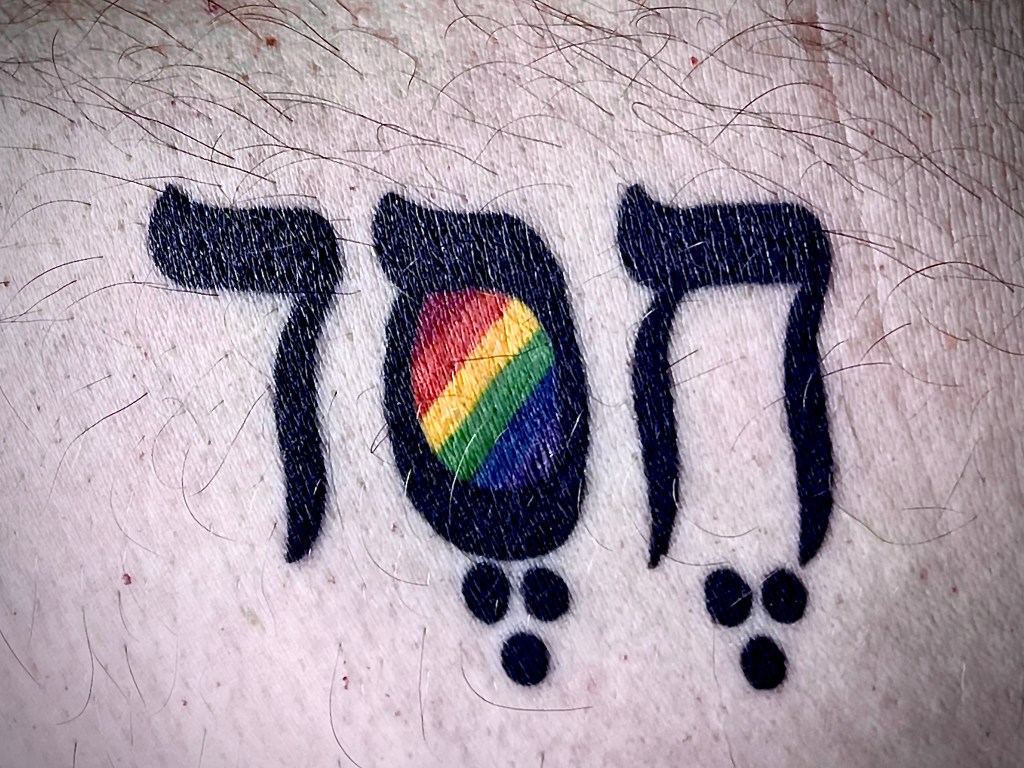
In late 2021, I got my first tattoo. I never thought I would get a tattoo, but felt the need to imprint the image at the top of this post as a reminder of where I have been, where I am going, and the One has been with me along the way.

It is the Hebrew word chesed, best translated loving-kindness or giving oneself fully, with love and compassion, and appears over 200 times in the Hebrew Bible. This image on my arm serves as a reminder of God’s chesed for me and my mission to bring chesed into the world. When I couldn’t love myself, God’s love sustained me. When I didn’t think God loved me, I trusted the idea of chesed. It has been an anchor and a safe harbor, sometimes the only thread of hope left to hold onto.

Inside the word chesed is a rainbow, a symbol carrying multiple meanings for me. It serves as a visual reminder of God’s promise of an everlasting covenant with me and all of creation while also symbolizing my full acceptance and love of myself, including my sexuality. The meaning of each color in the rainbow brings even more depth of meaning to this symbol on my arm: red = life; orange = healing; yellow = sunlight; green = nature; blue = serenity; purple = spirit.

Over these last five years, each has been an important part of my journey. I have found new love for life, healing from past wounds, warmth from actual and metaphorical sunlight, peace in nature, previously unknown serenity, and deeper connection with spirit within the divine flow.

Music has been another significant source of strength. While a handful of songs have spoken powerfully along the way, a song which has served as a constant anthem is Son by Sleeping at Last. You can listen to the song HERE; Below are the lyrics:

Show me who I am and who I could be.
Initiate the heart within me until it opens properly.

Slow down, start again from the beginning.
I can’t keep my head from spinning out of control.
Is this what being vulnerable feels like?

I swear I’ll try, try, try to breathe ’til it turns to muscle memory.
I’m only steady on my knees;
One day I’ll stand up on my own two feet.

I’ll run the risk of being intimate with brokenness.
Through this magnifying glass, I see a thousand finger prints
On the surfaces of who I am.

Show me where to find the silver lining
As the mercury keeps rising,
’Til the glass or my fever breaks.

Show me how to struggle gracefully.
Let the scaffolding inside of me be strong enough
To hold this tired body up once more.

And I will try, try, try to breathe ’til it turns to muscle memory.
I feel the pressure in my blood building up and liberating me.
So I will try, try, try to breathe ’til it turns to muscle memory.
I’m only steady on my knees.
But one day, I’ll stand on my own two feet.

I’ll run the risk of being intimate with brokenness.
Through this magnifying glass, I see a thousand finger prints
That ran the risk of being intimate with my brokenness.
I was given a gift of hope in a thousand finger prints
On the surface of who I am.

Completing this 52nd year of life, I realize how much has been learned and how much remains to be discovered. I am only six years from my mom’s age when she died; a sobering fact, bringing the brevity and fragility of life to the fore. This reality compels me to consider what to do with whatever days remain in this life.

The time has come to turn the page to a new chapter, one pursing deeper purpose and meaning. A blank page brings risk, fear, and uncertainty, but also opportunity and hope, dreams to discover and pursue.

I am incredibly thankful for those who have accompanied me on the journey. In some strange way, there is a even a certain thankfulness for those who have brought pain and suffering, or at least for the lessons they taught me or pointed me towards.

New friends have come into my life; some old ones have left. Others have walked with me for a season along a stretch of the path. Each has brought something valuable, things such as insight, challenge, compassion, and love. Whether still present or a fond memory, each holds a special place in my heart.

Like the lyrics above say, I have run the risk of being intimate with my brokenness. That intimacy has brought disappointment and fulfillment, suffering and joy. It has not always been easy or enjoyable, but it has been good. While still a work in progress, I continue moving forward. My greatest hope is it has all made me a better human being, allowed me to experience a deeper sense of God’s chesed, and given me opportunities to offer my whole self and a some chesed to those around me.

Drinking up meaning

In his book, Man’s Search Meaning, Victor Frankl writes, “When a person can’t find a deep sense of meaning, they distract themselves with pleasure.” Sitting with those words and reflecting on my life and our world, it seems there may be few words which speak more powerfully to our current struggle as individuals and a society.

We are surrounded by pleasure. We can binge hundreds of shows. We carry access to countless forms of entertainment and distraction in our pockets and purses. With a quick search on Google, Yelp, or a host of others apps, we can discover dozens if not hundreds of things to do with our time.

Most of us don’t do sitting still very well. Think about it…one of the most common answers to “How are you?” is “Busy.”

I am convinced one of the reasons we keep busy is to mask the absence of a deep sense of meaning in our lives. We run to pleasure and its cacophony of noises to drown out the ache in our soul.

We fear sitting still or in silence because it can be deafening, believing if we run fast enough, make enough noise, stay busy enough, we might forget the empty space deep inside crying out for meaning.

I have fallen into this trap throughout my life. Being an Enneagram 7, it happens fairly easily.

Life has slowly been teaching me to sit with pain and discomfort. Meditation practice over the last nine months has aided me in building mental and emotional muscles I didn’t realize were there.

While there is still have much to learn, I am beginning to understand something else Frankl says about pleasure: “Pleasure is, and must remain, a side effect or by-product, and is destroyed and spoiled to the degree to which it is made a goal in itself.”

He it right. When pleasure becomes the goal, it loses a certain level of enjoyment. It may taste good in the moment, but can often have a bitter aftertaste. This often brings us back to the well for more; the cycle continues, our pursuit of pleasure for pleasure’s sake draining our soul.

I don’t know all the answers, but have discovered some pathways heading in the right direction. I am learning that pursuing meaning produces pleasure, a pleasure deeper than anything we try to create. Meaning, true, deep meaning, offers a spring of living water and invites us to drink. Drink up!

Through the wilderness

In his book Thoughts in Solitude, Thomas Merton says the following…

Contradictions have always existed in the soul of man. But it is only when we prefer analysis to silence that they become a constant and insoluble problem. We are not meant to resolve ail contradictions but to live with them and rise above them and see them in the light of exterior and objective values which make them trivial by comparison. Silence, then, belongs to the substance of sanctity. In silence and hope are formed the strength of the Saints (Isaiah 30:15).

I know I often get stuck in overthinking and over analyzing a situation. Merton is right, silence can guide us above contradictions and allow us to see the bigger picture.

Silence will help us focus on that which is more important than those things we tend to fixate on.

“What really matters?” is a conversation starter which silence draws us towards.

First, however, it often asks us to walk through the wilderness of confusion, noise, and fear. It invites us to step out of the noisiness of our self-imposed prison of analysis—which we see as “safe”—and into that vast wilderness.

It can indeed be scary out there, but somewhere beyond our fear is the great space, a realm where the divine can truly be seen and known.

Ironically, that great space also lies hidden within us, and the journey though the wilderness is a journey inward as much as it is anything else.